
Who designs whole-home audio in Austin?
Whole-home audio should feel natural, consistent, and easy to use. Smarter Homes designs distributed music systems for interiors, outdoor living areas, guest spaces, pools, and multiple structures across the property.
From quiet background music to high-performance listening, every room is designed around its size, finishes, use, and desired sound quality.
What is whole-home audio, and who is it for?
Whole-home audio is one music system that plays in any room, patio or pool area, together or separately, from one app, keypad or voice command. It suits Austin homeowners who want music without speakers on shelves, and builders who want the wiring planned before drywall.
Speakers sit in the ceiling, the wall or the landscape. Amplifiers and streaming sources live in one equipment rack, not in each room. Smarter Homes designs, wires, installs and programs the system, and keeps supporting it after move-in.
How many audio zones does my home need?
Plan one zone for each space that should play its own music at its own volume. In custom homes across Westlake, Barton Creek and Tarrytown, the count usually grows once patios, the pool and a guest house are added.
A zone can hold two speakers or ten. An open kitchen and family room can share one zone. A primary suite, office and gym usually each want their own, because people use them at different times. Adding a zone later means new wire, so it pays to decide at the plan stage.
What are the ways to set up whole-home audio?
There are three common setups: one music zone for the whole house, separate zones controlled from your phone, or architectural high-fidelity with hidden speakers and a concealed subwoofer. They differ in control, sound quality and how much construction they need.
1. One zone for the whole house
One zone player drives speakers in every room. When you raise the volume, music gets louder everywhere at once. You can't set a different volume in each room or play something different in the kitchen than on the patio. It is the simplest and lowest-cost way to get music throughout the house.
2. Separate zones, controlled from your phone
One multi-zone amplifier powers several rooms, and each room is its own zone in an app on your phone. You can turn the patio up and the office down, or play a playlist in the kitchen while a game plays in the den. For most homes this is the middle of the road: real room-by-room control without dedicated listening rooms.
3. Architectural high-fidelity
Small-aperture speakers such as James, or invisible speakers floated into the drywall and finished over, keep ceilings and walls clean. Small drivers need help with bass, so we layer in a high-quality subwoofer that is either designed into the room or hidden. That adds construction, but you get high-fidelity sound without large speakers and heavy amplified equipment in the room.
| Setup | Volume per room | Different music per room | What you see | Construction |
|---|---|---|---|---|
| 1. One zone, whole house | No | No | Standard in-ceiling grilles | Speaker wire to each room |
| 2. Separate zones, app control | Yes | Yes | Standard in-ceiling or in-wall grilles | Wire from each zone to the amp location |
| 3. Architectural high-fidelity | Yes | Yes | Small apertures, or nothing at all | Back boxes, drywall finishing and a hidden or designed-in subwoofer |
Many homes mix them: architectural speakers in the great room and primary suite, and simpler zones in secondary rooms and the garage.
Which brands fit each setup?
Sonos is the name most people know, and it's a solid choice for setups 1 and 2. It's worth looking past it, though. Bluesound runs on BluOS and streams high-resolution audio, which you can hear on good speakers.
For a dedicated listening room or an enthusiast system, we also plan systems around McIntosh amplification and Sonus faber speakers. People choose them for the audiophile experience: detail, staging and build quality you notice from the first track. These systems sit above the calculator ranges below: a single listening room we recently completed came in around $100,000.
How much does whole-home audio cost?
The Home Technology Association budget calculator puts house music in a high cost-of-living market like Westlake and central Austin at about $1,700 to $5,900 per room, and $5,750 to $11,800 per room for higher-quality sound or higher-grade architectural finishes. Those ranges include labor, accessories, and design and engineering.
Standard sound lines up with setups 1 and 2 above. The higher-quality column lines up with setup 3, where finishes and a hidden subwoofer add cost. Audiophile listening rooms built on McIntosh and Sonus faber run well above both columns.
| Rooms with music | Standard sound | Higher-quality sound or finishes |
|---|---|---|
| 1 room | $1,725 – $5,885 | $5,751 – $11,770 |
| 5 rooms | $8,627 – $29,425 | $28,756 – $58,850 |
| 10 rooms | $17,254 – $58,850 | $57,513 – $117,700 |
Source: Home Technology Association budget calculator, US, "Expensive" cost of living (the setting for Westlake, West Lake Hills and central Austin), run November 2026. Rooms include outdoor areas. Tax and wiring are not included; HTA budgets new low voltage wiring separately. Your number depends on speaker grade, room size and how much is hidden.
How a higher-end room budget gets spent
In a higher-end great room or listening room, the speakers are usually high-end Sonance in-ceiling or in-wall models. The zone is driven one of two ways: a Sonos Port feeding a higher-power amplifier, or a lossless source plugged into a high-wattage amplifier. More than one subwoofer is common.
From there, the same HTA budget can be spent several ways:
- Heavier on subwoofers and mid-range speakers, for weight and impact.
- A basic subwoofer and higher-end ceiling speakers, for detail and clarity.
- More speakers in the room, for even coverage in a larger space.
Speaker form factor changes where the money goes
Speakers come in different form factors, and each one moves the budget differently. Three common paths for the same room:
- Larger grilled speakers, color-matched. You can choose a high-quality speaker with a larger grille and pay for labor to match the ceiling color, then spray the grilles with a low-luster oil-based paint so they blend in. The labor and paint use part of the budget and can push the room into a higher tier of the per-room audio range.
- Small-aperture speakers plus a subwoofer. Some owners would rather put that money toward entry-level James Loudspeaker Small Aperture models (James is part of Sonance), which show only a 3-inch or 4-inch round or square grille. They are fine seeing the small white grilles, so they leave them unpainted. The most compact model, the SA42-4, reaches down to about 70 Hz (James datasheet), so a subwoofer goes somewhere in the room for the low end.
- Top-fidelity small apertures, no subwoofer. Others want no subwoofers and big sound from small openings. They choose the highest-fidelity James models, which hide a larger woofer behind the same small grille and reach about 38 Hz (James Small Aperture brochure). A pair of those plus an amplifier can use the whole room budget.
Start with the HTA range for your room count. Then decide together with us where that money does the most for how you listen.
Which speaker goes where?
Use this as a starting point for your plans. Final speaker choices come from room size, ceiling height and finishes.
| Space | Typical speaker | Amplification | Wiring to plan |
|---|---|---|---|
| Kitchen, dining, hallways | In-ceiling or small-aperture speakers, spaced for even coverage | One rack amp channel pair per zone | Speaker wire home run from each location to the rack |
| Family room with TV | In-wall or in-ceiling left, center, right | One Sonos Amp per TV zone | HDMI ARC/eARC returned to the rack over a balun, so audio stays in sync |
| Great room or listening room | High-end Sonance in-ceiling or in-wall speakers with back boxes, often with more than one subwoofer | Sonos Port into a higher-power amp, or a lossless source into a high-wattage amp | Back boxes set at framing, sub location chosen early |
| Patio, pool, garden | Weather-rated speakers or landscape satellites with an in-ground subwoofer | Dedicated outdoor amp channels | Direct-burial wire or conduit set before hardscape is poured |
| Guest house, pool house, barn | Same as the matching indoor space | Local amp or a run back to the main rack | Fiber in conduit between structures, not long copper runs |
Typical layouts, not a quote. See low voltage prewire for wiring timing and fiber between structures for detached buildings.
Why do Sonos speakers drop out of the app?
Most dropouts are network problems, not speaker problems. Sonos needs the speakers and the phones that control them on the same network segment, Wi-Fi channels its speakers can use, and switches set up so a speaker never takes over the network.
These are the rules we set on every system we install:
- Every rack amp and stationary player is hardwired. Wi-Fi is only for portable speakers like a Move or Roam.
- Speakers and the phones that control them stay on the same VLAN. Splitting them is the most common cause of speakers vanishing from the app.
- Access points that serve wireless Sonos speakers stay off DFS channels.
- If IGMP snooping is on, a querier is running on the core switch, or grouping silently breaks.
- The core switch is set as the spanning tree root bridge, so a Sonos Amp never takes that role.
- Every amp has a reserved IP address, so keypads, Josh.ai and touchscreens keep finding it after a power outage.
Older Sonos S1 gear can't group with S2 gear, so we check for it during the first walk-through. More on the network side: whole-home Wi-Fi.
Questions to ask your builder before drywall
Bring these to your pre-drywall walk. They are the five items that are hard or costly to fix after paint.
- Where is the equipment rack, and does it have power, cooling and a network drop?
- Does every speaker location have its own wire run back to that rack?
- Are back boxes in place for the main listening room and theater speakers?
- Is conduit set to the patio, pool and landscape areas before the hardscape is poured?
- Is fiber, in conduit, planned to the guest house, pool house or detached garage?
Want a second opinion on your plans? Send them through our contact page and we will mark up the audio and network layout. For dedicated cinemas, see home theater installation.
Home Audio Installation in Austin
Smarter Homes installs home audio systems for new construction, remodels and existing homes across Austin, from one great room to every room, patio and pool on the property. One team handles the design, wiring, installation, programming and support, so the system sounds right and stays easy to use.
How a home audio installation runs
- Walk-through: which rooms and outdoor areas get music, and how you want to listen
- Design: zones, speaker types and placement, and where the rack lives
- Prewire: speaker wire and network cabling run before drywall in new builds and remodels
- Installation: in-ceiling, in-wall, small-aperture and outdoor speakers, plus amplifiers and streaming sources
- Programming: room grouping, volume and source control in one app, keypad or touchscreen
- Walk-through with your family, then ongoing support
In existing homes, wireless and hybrid systems add music where new wiring is hard. To start, book a consultation, or see home theater installation for dedicated cinemas.

What can a whole-home audio system include?
Smarter Homes designs audio systems that match the way each room is used. A kitchen may need subtle background music, while a great room, outdoor living area, or dedicated listening space may call for higher-performance speakers and more precise tuning.
We coordinate speakers, amplification, streaming, networking, control, and acoustic considerations so the system performs consistently while remaining easy to use and visually integrated into the home.
Common Whole-Home Audio Features
- Architectural in-ceiling and in-wall speakers
- Sonos multiroom audio and streaming
- High-performance listening zones
- Outdoor and landscape audio
- Acoustic treatment where needed
- Centralized amplification and equipment racks
- Josh.ai and smart home control integration
- Networking designed to support reliable streaming
What wiring, rack and outdoor planning does it need?
Rack, Wiring, & System
A reliable whole-home audio system depends on proper wiring, amplification, network infrastructure, and equipment layout. Smarter Homes plans pathways, rack locations, and system infrastructure so streaming, control, and room-to-room audio remain reliable and easy to service.
Outdoor & Estate Audio
Patios, pools, gardens, lakefront areas, and larger properties require careful coverage planning. Smarter Homes designs outdoor audio using weather-rated speakers, landscape solutions, appropriate amplification, and system layouts that provide consistent sound without relying on excessive volume.
What should you decide before designing an audio system?
The best audio system starts with how you want to use the home, not with a specific speaker or product.
Consider:
- Which rooms and outdoor areas should have music
- Whether different spaces need independent audio zones
- Where you want subtle background music versus higher-performance listening
- Whether the project is new construction, a remodel, or a retrofit
- How you want to control music throughout the home
- Whether future expansion should be planned into the system
Smarter Homes uses these decisions to define the right speaker types, amplification, streaming platform, wiring, networking, and control strategy for the property.
If a room needs immersive surround sound and a big screen, that is a different design. See home theater installation for dedicated cinemas.
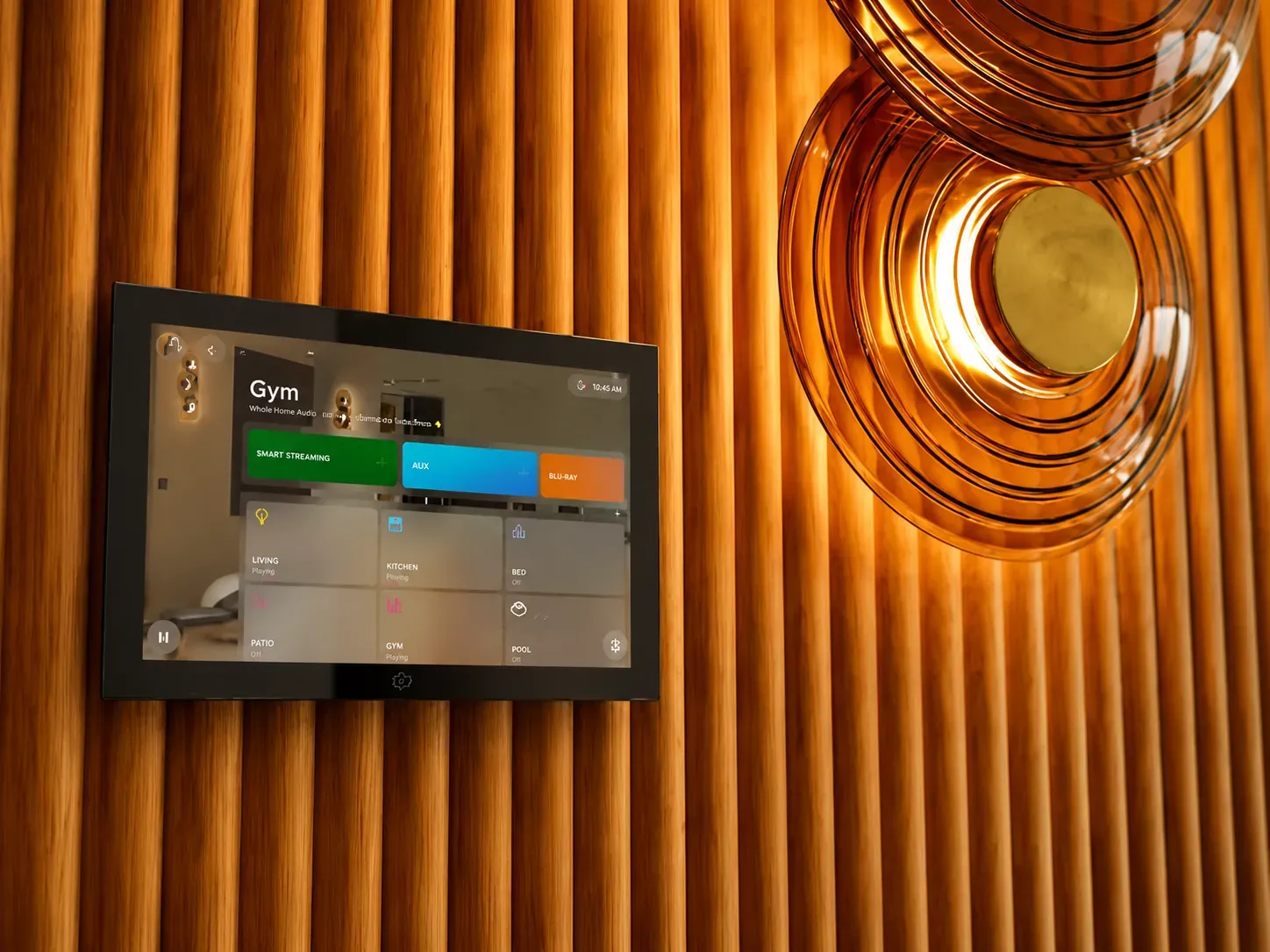
How do you control whole-home audio?
A well-designed whole-home audio system should be easy to use, whether you are playing music in one room or throughout the entire property.
Smarter Homes can coordinate streaming, room grouping, volume, source selection, and audio scenes through intuitive app control, keypads, touchscreens, remotes, and supported smart home control platforms.
Behind the scenes, centralized equipment, amplification, networking, and programming are engineered to work together so the homeowner does not have to manage the complexity.
More reading: how distributed whole-home audio works and how to pick the right Sonos speaker.
Project videos: an outdoor audio system, and a 27-acre property with four structures on one fiber network.
Explore 27 Acres and 4 structures of high-speed WiFi, long-range Gate Control, Security Cameras, and Distributed Audio Video over a Fiber infrastructure.
Our partners


