
Banner photo: a Qolsys alarm panel in a Westlake home. Photo: FOGO Content
Texas DPS licensed (B28437501) · HTA Estate Certified · 160+ five-star Google reviews
Home security and alarm systems for Austin homes
A home security system from Smarter Homes is a Qolsys alarm panel with encrypted PowerG sensors on every door, window and protected space, monitored through Alarm.com. It covers the house from the walls in: intrusion, smoke and heat, carbon monoxide and water. Cameras are a separate system that covers the walls out.
We design, install, monitor and service alarm systems for homes in Austin, Westlake, West Lake Hills, Barton Creek, Tarrytown, Bee Cave, Spanish Oaks, Rollingwood and Lake Austin waterfront homes, working from West Lake Hills since 2006 under Texas DPS Private Security License B28437501.
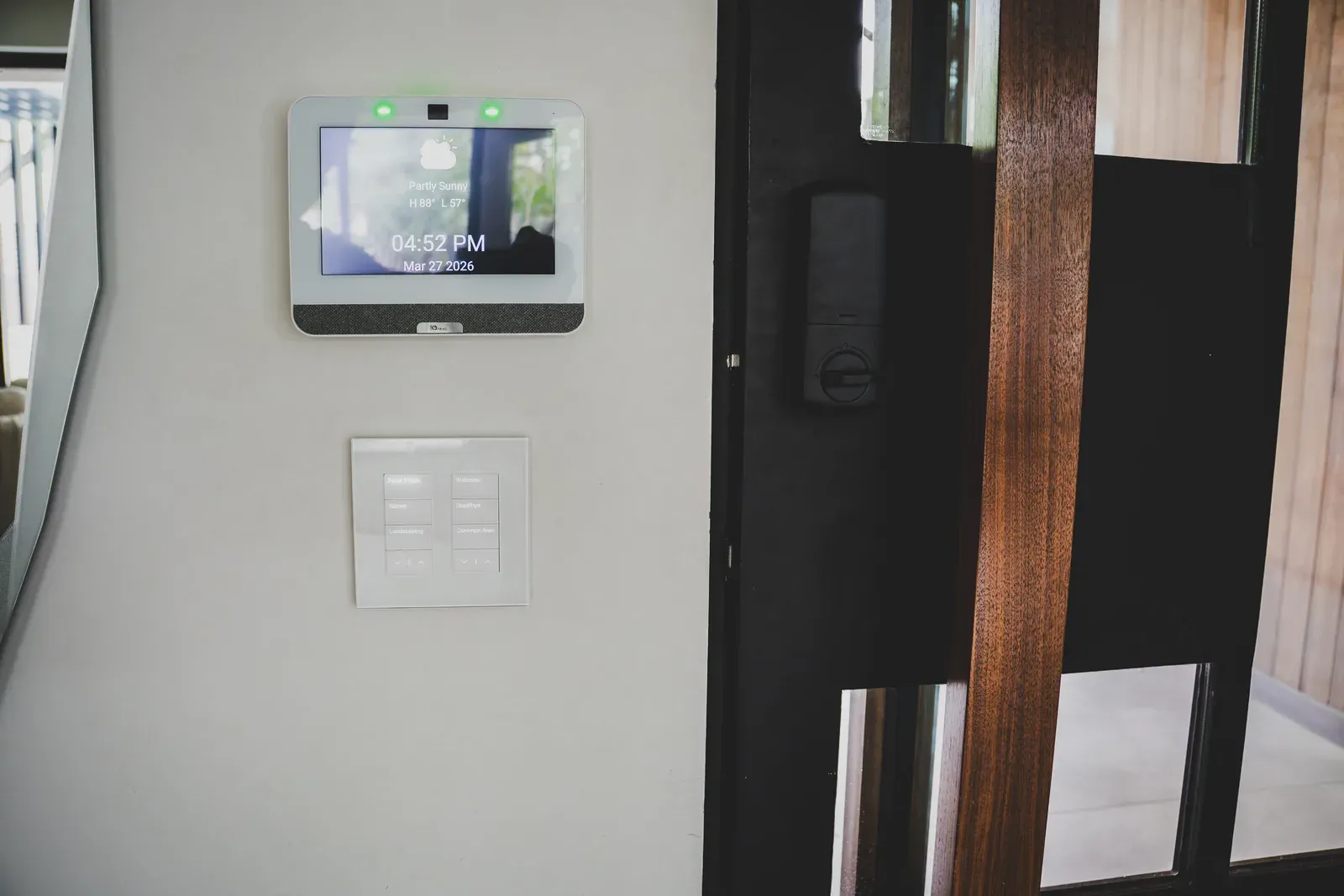
How does a home alarm system work?
A home alarm system works in four steps: sensors on doors, windows and rooms detect a change, the Qolsys panel decides whether it is an alarm based on how the system is armed, the panel sends the signal over cellular to a staffed monitoring center, and the center verifies it with you before dispatching police.
| Step | What happens | Typical timing |
|---|---|---|
| 1. Detect | A PowerG door contact, motion sensor or glass-break sensor reports to the panel over encrypted radio | Instant |
| 2. Decide | Armed Stay watches doors and windows only; Armed Away adds motion. An entry door starts a countdown so you can disarm at the keypad or from your phone | Entry delay set per door |
| 3. Report | The siren sounds and the panel sends the alarm over cellular through Alarm.com, so a cut phone or internet line does not stop it | Seconds |
| 4. Verify and dispatch | The monitoring center calls the people on your list; with no answer or a wrong passcode, it requests police | Usually within a minute or two |
Every system we install has the same four parts: a Qolsys touchscreen panel, PowerG wireless sensors, Alarm.com for the app and monitoring connection, and a cellular communicator with battery backup. PowerG sensors talk to the panel on 915 MHz, encrypted two-way radio that reports battery, tamper and a regular check-in, so a dead or missing sensor shows up before it matters.
The panel also runs a Z-Wave network for smart deadbolts, so arming can lock the doors, and the armed or away status reaches your home automation through Josh.ai, so night mode can close the garage, lower shades and turn on exterior lights.
Do I need an alarm, cameras, or both?
An alarm and cameras do different jobs, so we design and price them as two systems. The alarm covers the walls in: it detects a break-in, fire, carbon monoxide or a leak and starts a response. Cameras cover the walls out: they show and record what happens around the property.
An alarm without cameras tells you something happened but not who or why. Cameras without an alarm record a break-in that nobody responds to. Most clients start with the alarm, because it is the part that reaches a monitoring center when nobody is home.
Cameras and video doorbells run on UniFi Protect, a separate walls-out system that records to equipment in your home. They have their own pages: security camera installation in Austin and video doorbells. Gates, intercoms and the garage are covered on gates and garage doors, and locks on smart locks.
What clients say
“Pete and his team were timely and professional. They set up our house-wide audio system, internet, and security system quickly and have kept it in working order since.”
Westlake-area homeowner, Google review, October 2025
“With 10 years of experience managing estates for elite clients, I’ve worked with many smart home companies, but none compare to Peter and his team. … they offer the utmost discretion and prioritize the highest level of security.”
Chantell P., estate manager, Google review, August 2024
DIY kit, national alarm company or a designed system: which fits?
A DIY kit fits a smaller home where you are happy to self-monitor. A national alarm company fits a standard home that needs a monitored package. A designed system fits a large home with many openings, glass walls, detached buildings or staff, where every door and room needs the right sensor and the alarm has to work with the rest of the house.
| DIY kit | National monitoring company | Designed system (Smarter Homes) | |
|---|---|---|---|
| Who installs | You | A company technician, standard package | Our licensed team, designed room by room |
| Sensors | A hub and a few sensors | A set package, with add-ons | PowerG sensors on every opening and risk point, chosen for the house |
| Monitoring | Self-monitored, or an optional plan | Central station | Central station through Alarm.com |
| Works with | The brand app | The brand app | Locks, garage, gates, shades and lighting through Josh.ai |
| Large homes | Range and sensor limits | Package limits | Guest houses, garages and detached buildings on one panel |
| Best for | Apartments and smaller homes | Standard homes on a budget | Large and custom homes in Westlake, Barton Creek and on Lake Austin |
None of these is wrong. The question is how many openings the house has, how much glass, who comes and goes, and whether the alarm needs to talk to the rest of the home.
We do not sell DIY kits or self-install packages. Smarter Homes is a concierge service: we design, install, monitor and service every system ourselves, and the same team answers when you call.
Which sensors does an Austin home need?
Start with contacts on every exterior door and accessible window, motion sensors in the main paths through the house, and smoke, heat and carbon monoxide detection on every level. Then add water and freeze sensors where a leak would do the most damage, and glass-break sensors in rooms with large glass walls.
| Sensor | What it catches | Where we put it |
|---|---|---|
| Door and window contacts | A door or window opening while the system is armed | Every exterior door, the garage entry door and accessible windows |
| Motion sensors | Movement inside when the home is armed away | Main halls, stairs and large rooms; pet-immune models where pets stay home |
| Glass-break sensors | The sound of breaking glass, before anyone enters | Rooms with large glass walls or sliders, common in Westlake and Lake Austin homes |
| Smoke and heat | Fire, with alerts to your phones | Every level, bedrooms and halls; heat detectors in garages and kitchens |
| Carbon monoxide | CO from gas appliances, fireplaces or an attached garage | Each level and near sleeping areas |
| Water and freeze | A leak, or a pipe close to freezing | Water heaters, laundry, under sinks, wet bars and exterior plumbing walls |
Smoke and fire alerts go to the homeowners' phones. A direct line to the fire department is separate and addressed individually, because false fire alarms carry real costs. We talk through that choice with each client.
Who monitors the alarm, and why does a Texas monitoring center matter?
Our clients' alarms are monitored by Dispatch Center, Ltd., a Texas-owned central station in San Antonio that has monitored alarms for independent Texas alarm companies since 1996. Every dispatcher is licensed by the Texas DPS, the center is a fully redundant UL-listed facility, and it works only for licensed dealers, never selling to homeowners itself.
| Dispatch Center, Ltd. | |
|---|---|
| Location | 101 Galleria Fair, San Antonio, TX 78232 |
| Phone | (210) 491-3400 |
| Licenses | Texas DPS (TPSB) B08709 / Y00228 · State Fire Marshal ACR-2247 · UL S 7157-1 |
| Monitoring since | 1996 |
| Who it serves | Licensed security and fire dealers only (wholesale) |
| Services | Burglary, fire and life-safety signals; two-way voice and video alarm verification |
Sources: Dispatch Center · Dispatch Center contact and licenses · Dispatch Center company profile
The people on the other end of your alarm
Dispatch Center is a small team by design; its own line is "the right size to be friendly." The dispatchers are Texans working in San Antonio, licensed by the DPS and trained every month beyond what the state requires. Because the center only works for alarm companies like ours, your account is never a sales lead for them, and we can set the call list, the scripts and the notification order for each home, such as calling the house manager before the owners or calling a guest-house caretaker first.
Here is what happens when a door opens at 2 a.m. in an armed home in Westlake: the Qolsys panel sends the signal over cellular and Wi-Fi at once; a dispatcher in San Antonio sees the zone name, the address and your instructions; they call the home and then your call list, ask for the passcode, and if nobody cancels, they call the police department that actually covers that street. In West Lake Hills that is a different dispatch number than in the City of Austin, and the dispatcher already knows it.
Most national alarm brands route every alarm in the country to a few large monitoring centers out of state. That works, but an operator in another state may not know that West Lake Hills uses its own dispatch number (512-974-0845, option 3) rather than Austin 911.
Texas law requires any company that monitors an alarm for a Texas home to hold a DPS license, and every operator to hold an individual alarm systems monitor license. It also requires your alarm company to tell you the name, address, phone number and license number of the company that monitors your system if that work is subcontracted. Ask any company you are considering for that information. Ours is above, and we put it in writing.
Sources: Texas Occupations Code 1702.105, 1702.224 and 1702.288
How the alarm reaches the monitoring center
The Qolsys panel sends every alarm two ways at once, over LTE cellular and over your home Wi-Fi, so a cut cable, a dead router or an internet outage does not stop the signal. This is called dual-path reporting, and it is how we set up every system.
The cellular radio is built into the panel, and each panel is ordered for one carrier, AT&T or Verizon. We check carrier signal where the panel will be mounted, which matters in the hills of Westlake, Barton Creek and along Lake Austin, where coverage changes from one street, or one room, to the next.
Alarm.com gives you arming, disarming, user codes with schedules for staff and contractors, and an activity history from your phone. Smoke, heat, carbon monoxide and water alerts go to the people you choose; burglary goes to the monitoring center for dispatch.
Want monitoring explained step by step? See how a monitored system works.
Sources: Qolsys IQ Panel 4 specification sheet · Qolsys support: dual-path communication
What happens when the power or internet goes out?
The alarm keeps working. The Qolsys panel switches to its backup battery, rated for more than 24 hours, and keeps reporting over cellular, so monitoring continues without power or internet. The panel tells you and the monitoring center that power was lost, and freeze sensors warn you before pipes burst during a long Texas outage.
Wireless PowerG sensors run on their own batteries, so they keep reporting during an outage. Hardwired smoke detectors required by building code have their own battery backup and are a separate system from the monitored alarm. For homes that need everything to stay on, we tie the panel and network into whole-home power backup.
Qolsys rates the panel's lithium-ion backup battery for more than 24 hours of standby, and the panel reports the power loss to you and the monitoring center as soon as it happens (Qolsys spec sheet). For outages longer than that, the panel should be on whole-home power backup.
How do you warn me before a pipe freezes?
With an outdoor temperature probe on the alarm. A wireless PowerG temperature sensor inside the home reads a waterproof probe mounted outside, and the system alerts you as the temperature drops toward freezing, hours before a pipe bursts. Water sensors under sinks and water heaters still matter, but they only tell you after the water is on the floor.
| Layer | What it does | When you find out |
|---|---|---|
| Outdoor temperature probe | Watches the outside temperature and the cold sides of the house, with up to four alert points | Before the freeze: time to drip faucets, open cabinets or send the house manager |
| Low-temperature sensors indoors | Watch attics, garages, crawl spaces and empty guest houses | When a space with plumbing gets cold enough to freeze |
| Leak sensors | Detect water at water heaters, laundry, sinks, wet bars and ice makers | After a leak starts |
| Automatic water shutoff (where fitted) | Closes the main water valve when a leak is detected | Stops the damage, even when nobody is home |
The PowerG temperature sensor runs on a lithium battery rated for about seven years, is supervised by the panel like every other sensor, and its probe sits on an 11-foot waterproof lead so the sensor itself stays indoors. Alerts go to you and anyone you choose, such as a house manager, and can also go to the monitoring center.
Sources: DSC PowerG temperature detector · PGTEMP-PROBE specifications
Does the alarm work with my lights, shades, music and garage?
Yes. The alarm is the walls-in system, and through Alarm.com it can drive the rest of the house: arming at night can close the garage, lower the Lutron shades, set the lights and stop the Sonos music, and an alarm can turn on every light in the house. Josh.ai works with Qolsys panels, so you can check or arm the alarm by voice.
| System | What the alarm can do with it |
|---|---|
| Lutron lighting (RadioRA 3, HomeWorks QSX) | Turn lights on or off on arming, disarming or an alarm; light schedules |
| Lutron shades | Lower or raise individual shades from the same rules |
| Sonos | Play, pause and set volume on speakers or groups from the Alarm.com app and scenes |
| Smart locks | Lock every door on arming; per-person codes with schedules |
| Garage doors (myQ) | See if the garage is open, close it remotely and close it when the system arms |
| Josh.ai | Ask for alarm status or arm the system by voice, with Josh scenes that include the alarm |
Each subsystem still runs on its own if the internet or another system is down: the lights work from their keypads, the garage from its buttons and the alarm from its panel. Gates, garage doors and myQ are covered on gates and garage doors; lighting on lighting control; shades on motorized shades; music on whole-home audio; and Josh.ai on home automation.
Sources: Alarm.com Lutron integration · Alarm.com Sonos integration · myQ and Alarm.com · Works with Josh
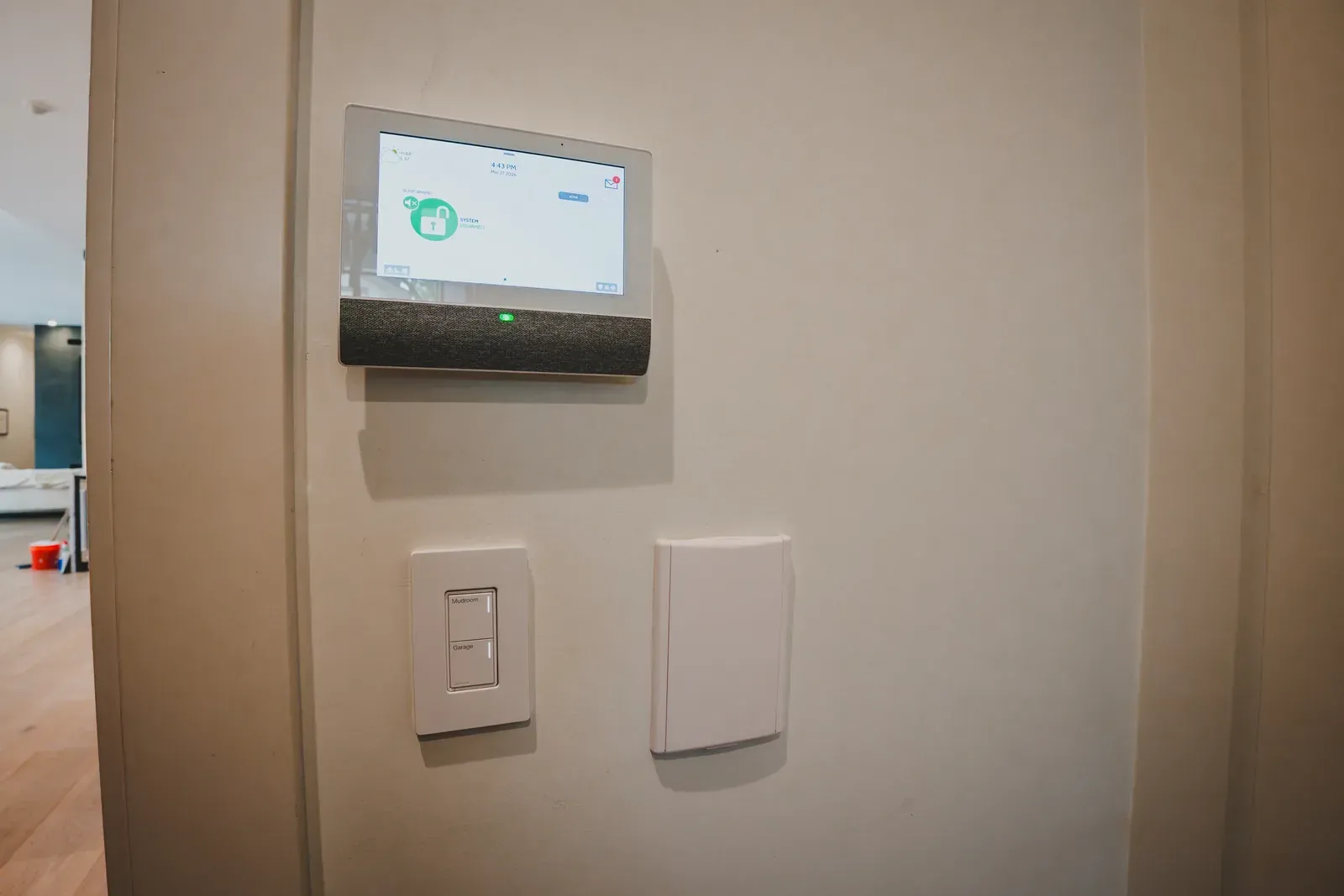
Project: an alarm planned with the lighting in a West Lake Hills modern home
In a new modern home in West Lake Hills, we planned the alarm, the Lutron lighting, the Wi-Fi and the security cameras together, before the walls closed. The Qolsys panels sit beside the Lutron keypads at the entry and in the main hall, so arming, lighting and the front door lock live in one place.
| What we did | |
|---|---|
| Alarm | Qolsys touchscreen panels at the entry and main hall, PowerG sensors, Alarm.com monitoring |
| Locks | Smart deadbolt at the front door, locked by the alarm on arming |
| Lighting | Lutron lighting control with keypads near the entries and along the main paths |
| Cameras and network | Security cameras and Wi-Fi access points placed for coverage, cabled back to one equipment rack |
| Planning | Wiring, panel space and power settled with the lighting plan before drywall |
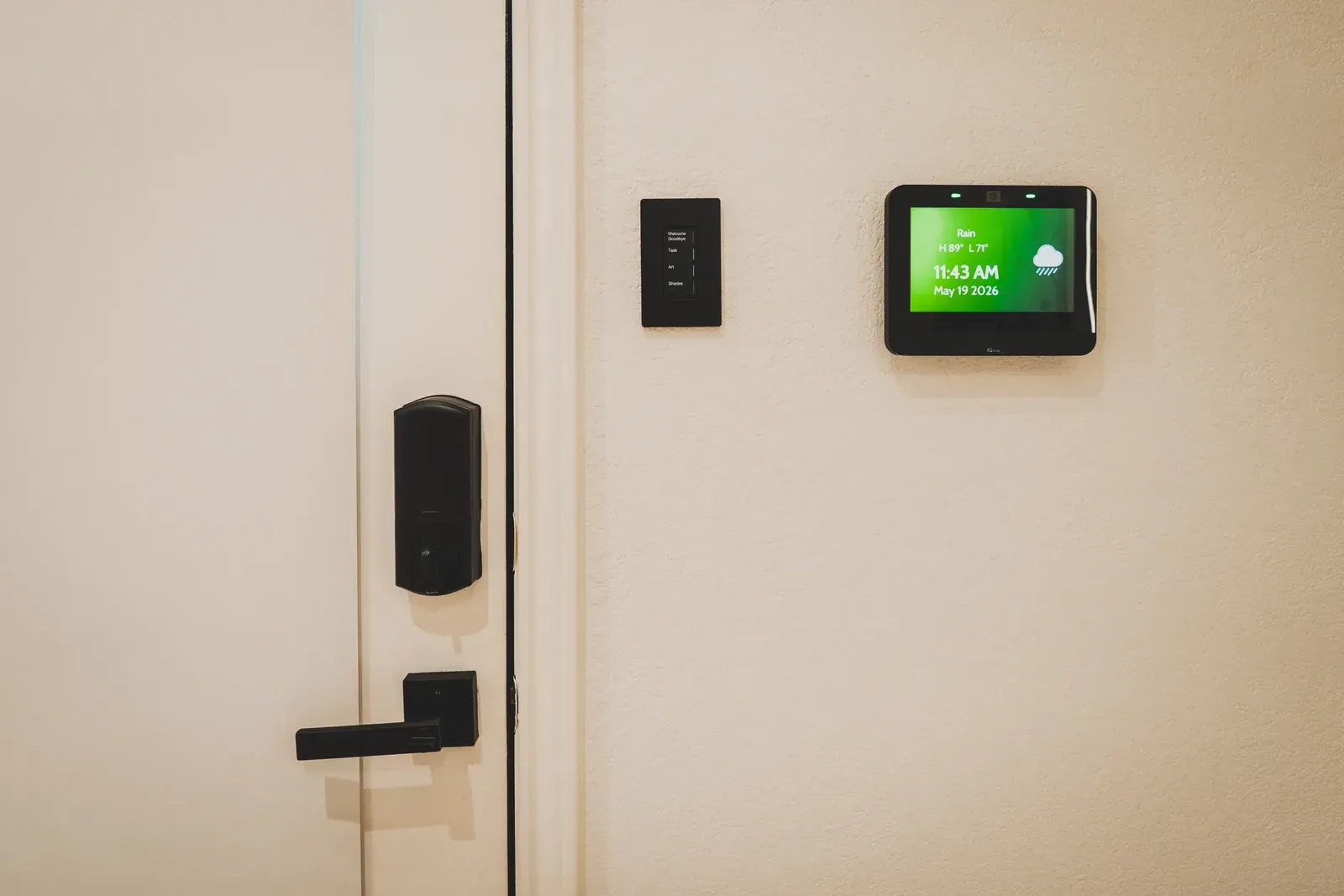
The photos on this page of the front entry and hallway panels are from this home. The full lighting story is on Austin Lutron: a West Lake Hills modern home with Lutron lighting, Wi-Fi and security.
Who manages the door codes for staff and contractors?
You do, or your house or property manager does, from the Alarm.com app. Smart locks on the alarm let you create a code for each person, choose which doors and the alarm it works on, and limit it to set days and hours or a one-time window. Codes change in minutes, with no locksmith or alarm company in the middle.
| Code type | Example | Who it fits |
|---|---|---|
| Always on | Family and the house manager | People who live or work at the home full time |
| Scheduled | Monday and Wednesday, 8 a.m. to 4 p.m. | Housekeeping, pool and landscape crews, dog walkers |
| Temporary | Friday 8 a.m. to Sunday 6 p.m. | Guests, contractors on a project, a weekend rental |
| Removed | Deleted the day someone leaves | Former staff or vendors |
Every code is tied to a name, so the activity history shows who unlocked which door and when, and the same code can disarm the alarm only if you allow it. This is the walls-in side of access control; gates and intercoms are on gates and garage doors, and lock choices are on smart locks.
Sources: Alarm.com scheduled and temporary codes · Alarm.com user codes
Can I change the sensor batteries myself?
Yes, and we set you up to. At handover you get a list of every sensor in the home with its location, battery type and part number, plus links to order replacements, so you or your house manager can swap a battery in a few minutes instead of booking a service call.
The panel reports low batteries weeks ahead, by sensor name, in the Alarm.com app. We walk you or your house manager through a battery change during handover, and we are a call away if a sensor needs more than a battery.
Do I need an alarm permit in Austin, West Lake Hills or Bee Cave?
It depends on who sends police to your address. Inside City of Austin limits, a $50 yearly permit is required before the alarm is turned on. West Lake Hills does not require a permit. Unincorporated Travis County requires a $50 calendar-year permit from the Sheriff. Bee Cave requires registration. We check the jurisdiction for each address and file the paperwork with you.
| Where the home is | Permit | Cost | False alarms |
|---|---|---|---|
| City of Austin (Tarrytown, and Austin addresses in Barton Creek and on Lake Austin) | Required before the system is turned on, renewed every 12 months | $50 a year | Fees apply after the third false alarm in 12 months, and police responses to an unpermitted alarm are charged |
| West Lake Hills | Not required | None | Give your alarm company the dispatch number: 512-974-0845, option 3 |
| Unincorporated Travis County | Required, valid through December 31 | $50 a year | Fees apply after repeated false alarms |
| Bee Cave (including Spanish Oaks addresses inside city limits) | Registration required by city ordinance | Confirm with Bee Cave Police | Confirm with Bee Cave Police |
| Rollingwood | Confirm with Rollingwood Police |
Sources: City of Austin Alarm Administration · Austin permit application · City of West Lake Hills · Travis County Sheriff's Office. Checked November 2026; fees change by ordinance.
How do you prevent false alarms?
Most false alarms come from four things: an entry delay that is too short, motion sensors that see pets or moving air, weak or aging sensors, and people who do not know the code. We set entry delays per door, use pet-immune motion sensors, standardize on supervised PowerG sensors and give housekeepers, staff and contractors their own scheduled codes.
If an alarm goes off by accident, disarm it and wait for the monitoring center's call; give your passcode and the dispatch is cancelled. The City of Austin asks residents not to call 911 to cancel an alarm.
How much does a home security system cost in Austin?
A professionally installed alarm and fire detection system for an Austin home runs $4,601–$21,186 for 4,000 sq ft, $6,902–$31,779 for 6,000 sq ft and $11,503–$52,965 for 10,000 sq ft, using the Home Technology Association's budget calculator at its "Expensive" cost-of-living setting. Monitoring is a separate monthly fee: Smarter Homes monitoring starts at $59.99 a month plus tax.
Two numbers make up the cost: the one-time installation, which depends on how many openings and protected spaces the home has, and the monthly monitoring, which depends on what is monitored. Cameras, gates and the network are separate systems with their own budgets.
Before the table, three tiers explain what moves a home from the low end of a range to the high end:
Tier 1, self-installed alarm. A retail kit with a hub, a few door sensors and app alerts, set up by the homeowner. HTA does not budget it, because it falls outside a professional install.
Tier 2, professional intrusion system. A Qolsys panel, PowerG contacts on exterior doors and accessible windows, motion sensors, cellular monitoring and smoke and CO detection. This is the low end of each HTA range.
Tier 3, full-property protection. Every opening, glass-break sensors on large glass walls, water and freeze sensors at every risk point, heat detection in garages, detached structures and guest houses on the same panel, and staff codes with schedules. This is the high end of each range.
| Home size | Scope | HTA budget, Expensive setting |
|---|---|---|
| Any size | Tier 1, self-installed kit | Not budgeted by HTA |
| 4,000 sq ft | Alarm and fire detection, Tier 2 to Tier 3 | $4,601–$21,186 |
| 6,000 sq ft | Alarm and fire detection, Tier 2 to Tier 3 | $6,902–$31,779 |
| 10,000 sq ft | Alarm and fire detection, Tier 2 to Tier 3 | $11,503–$52,965 |
Source: Home Technology Association budget calculator, "Expensive" cost-of-living setting, run November 2026. HTA states its ranges include labor, accessories, and design and engineering; tax and monitoring fees are not included.
What moves the price up or down
| Factor | Why it matters |
|---|---|
| Number of openings | Every exterior door and accessible window gets a contact, so a home with 60 openings costs more than one with 25 |
| Glass walls and sliders | Large glass needs glass-break sensors in addition to contacts |
| Detached buildings | Guest houses, pool houses, garages and docks need their own sensors and sometimes a range extender |
| Water and freeze protection | Leak sensors, outdoor temperature probes and automatic shutoff valves add parts and labor |
| New build or retrofit | Before drywall, wired keypads and sirens are easy to place; in a finished home we use wireless PowerG sensors to avoid opening walls |
| Existing equipment | A released Qolsys panel or working legacy sensors can lower the cost of a takeover |
Cameras, gates and the network are separate HTA lines. For a range built from your own home, use our smart home budget tool.
What does Texas DPS License B28437501 mean?
License B28437501 is our Texas DPS Private Security company license. Texas law requires it of any company that sells, installs, services or monitors alarm systems, and each installer must also hold an individual DPS registration. You can check any company's license with the DPS Private Security program before hiring.
Texas regulates this work under Occupations Code Chapter 1702. A Class B security services contractor license covers alarm and electronic access work. Before hiring, ask for the company license number and the installer's DPS registration card.
Sources: Texas Occupations Code Chapter 1702 · Texas DPS company license types
Can you take over an existing ADT, Vivint or Brinks system?
Often, yes, but it depends on the panel. Open Alarm.com panels such as Qolsys can move to us once the old company releases the panel's cellular radio from its account. Proprietary panels, such as the Vivint Smart Hub and Sky panels and the ADT Command touchscreen, only work with that company and have to be replaced, though many of the sensors can stay.
| What is on your wall | Can it move to us? | What we do |
|---|---|---|
| Qolsys IQ Panel (Brinks, ADT, local dealers) | Yes, once the old company releases the panel from its Alarm.com account | Re-enroll it on our account, update the firmware and re-test every sensor |
| ADT Command touchscreen | No. ADT locks the firmware to its own service | Install a Qolsys panel; reuse compatible sensors |
| Vivint Smart Hub or Sky panel | No, it only works with Vivint | Install a Qolsys panel; the 345 MHz sensors and Z-Wave locks can often move |
| Older Honeywell, DSC or 2GIG systems | Usually the sensors, not the panel | A Qolsys panel with a legacy sensor card that reads the old 319.5, 345 or 433 MHz sensors |
The Qolsys panel has slots for legacy sensor cards, so a home full of working older sensors does not have to be torn out on day one. We usually keep the old sensors where they test well and replace them with PowerG as batteries or performance call for it. Any equipment financing with the previous company stays with that company; cancel monitoring only after we confirm the panel model and the release.
Sources: Alarm Grid: ADT Command · Alarm Grid: Vivint panels · Qolsys panel release · Qolsys legacy sensor cards
The cost of a locked panel shows up when you leave. With an ADT Command or Vivint panel, the touchscreen, the communicator and the hub are tied to that company's firmware and account, so the core of the system, usually the largest part of what you paid, goes in the trash. Only some sensors and Z-Wave devices carry over.
Before you switch: get released by your current company
Your current alarm company has to release the panel from its account before anyone else can monitor it, and many will not release it until your contract has ended or been paid off. Ask for your contract end date, any buyout amount and a written release before you cancel, so you are never left with a panel nobody can monitor.
We check the panel model, the contract and the release with you before anything changes, and we schedule the switch so the home is never unmonitored.
Can another company take over a system you install?
Yes, at any time. We install open Qolsys panels on Alarm.com with no proprietary firmware, so any Alarm.com dealer can take over monitoring and service. When a client asks, we release the panel from our account and the equipment stays on the wall.
Leaving costs nothing. Whatever the system, every Smarter Homes agreement ends with complimentary offboarding: we release the panel, close out the agreement and help you move on to the next company.
We think that is how it should work. You own the equipment, and we keep clients by doing the work well, not by locking the panel.
What does alarm monitoring cost per month?
Smarter Homes monitoring starts at $59.99 a month plus tax, through Dispatch Center, a Texas-licensed central station in San Antonio, with dual-path cellular reporting. National big-box alarm brands ran $15 to $53 a month in Consumer Reports' member survey. The price moves with what is monitored (burglary only, or fire, CO and water too), dual-path cellular and who staffs the monitoring center. We quote monitoring in writing with the system design.
When you compare monthly prices, ask three things: where the monitoring center is and who licenses it, whether the price includes cellular and fire monitoring, and whether you own the equipment if you leave. A low monthly rate tied to a long contract and financed equipment is the most common complaint in Austin homeowners' threads.
Source: Consumer Reports home security buying guide, survey of members, updated July 2026. Checked November 2026.
Will an alarm lower my homeowners insurance?
Usually. The Texas Department of Insurance lists a monitored burglar or fire alarm as a common discount, and each insurer sets its own amount. Chubb's Texas Masterpiece policy, for example, lists 7% for a central-station burglar alarm and another 7% for a central-station fire alarm. You need central-station monitoring and an alarm certificate for your insurer.
Water and freeze protection is where the larger credits are moving. Chubb lists premium credits for a temperature-monitoring system that triggers a central-station alarm and for a leak-detection system that covers every area with plumbing. PURE lists up to 5% for an automatic water shutoff with low-temperature monitoring. Mercury offers a leak-detection discount in Texas.
Sources: Chubb home discounts · PURE water damage prevention · Mercury leak detection
The certificate names your address, the monitoring center and what is monitored: burglary, fire, carbon monoxide, water or low temperature. Water and freeze sensors matter in Texas, where water damage drives many claims. Send the certificate to your agent and check your declarations page at renewal for the credit.
Sources: Texas Department of Insurance · Chubb Texas Masterpiece discounts
Home alarm questions
Do I need a permit for my alarm in Austin?
Yes, inside City of Austin limits: a $50 residential permit, renewed every 12 months, filed before the system is turned on. West Lake Hills does not require one. Unincorporated Travis County requires a $50 Sheriff permit.
Does the alarm work without internet or power?
Yes. The Qolsys panel reports over cellular and runs on its backup battery, so monitoring continues through an internet or power outage.
Is a monitored alarm worth it if I already have cameras?
Cameras record what happens; the alarm is what reaches a monitoring center and dispatches police when nobody is watching the app. Cameras are a separate UniFi Protect system that works alongside the alarm.
Can you take over my ADT, Vivint or Brinks system?
Often. An open Qolsys panel on Alarm.com can move to us once the old company releases it. Proprietary panels such as ADT Command and Vivint hubs have to be replaced, though many sensors can stay.
Can smoke, CO and water sensors be on the same system?
Yes. Smoke, heat, carbon monoxide, water and freeze sensors all run on the same Qolsys panel and alert your phones through Alarm.com.
Can the alarm lock the doors and close the garage?
Yes. Arming can lock Z-Wave deadbolts, and through Josh.ai the armed state can close the garage, lower shades and turn on exterior lights.
What happens if I leave Smarter Homes?
Every agreement ends with complimentary offboarding, whatever the system. We release the alarm panel from our account, close out the agreement and help the next company take over. The equipment stays yours.
Do you sell DIY alarm kits?
No. Smarter Homes is a concierge service: we design, install, monitor and service every system ourselves.
Is Smarter Homes licensed to install alarms in Texas?
Yes. Smarter Homes holds Texas DPS Private Security License B28437501.
Who installs alarm systems in West Lake Hills and Westlake?
Smarter Homes designs, installs and services alarm systems across Westlake and West Lake Hills from our showroom at 5524 Bee Caves Rd, Unit J8, West Lake Hills.
How much does a home security system cost in Austin?
A professionally installed alarm and fire detection system runs $4,601–$21,186 for a 4,000 sq ft home, $6,902–$31,779 for 6,000 sq ft and $11,503–$52,965 for 10,000 sq ft, using the Home Technology Association budget calculator at its Expensive setting. Monitoring is separate and starts at $59.99 a month plus tax.
How much does alarm monitoring cost per month in Austin?
Smarter Homes monitoring starts at $59.99 a month plus tax, with a Texas-licensed central station and dual-path cellular. National big-box brands ran $15 to $53 a month in Consumer Reports' member survey. The price depends on what is monitored, such as burglary, fire, carbon monoxide and water, and whether the plan includes cellular reporting.
Builders and architects
Send floor plans (PDF) and we will mark sensor zones, the panel and keypad locations, smoke and CO coverage and the wiring the alarm needs before drywall.
Homeowners
Book a walkthrough of your home, or a session at our West Lake Hills showroom, 5524 Bee Caves Rd, Unit J8. Call (512) 775-6101.